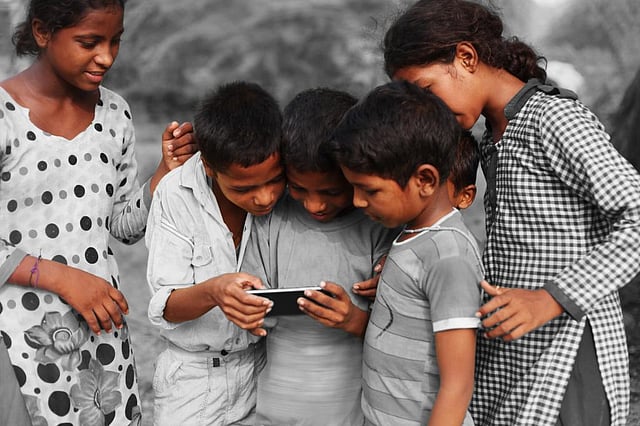
Adolescent Girls in front of aggressive explosion of internet abundance

India’s youth mental health crisis is wearing a new face, and it is overwhelmingly female. Today, millions of adolescent girls are caught in an unprecedented psychological storm driven by the sudden, aggressive explosion of internet abundance. Yet, look closely and you will see that this digital tide has split the country cleanly in two. On one side of the geographic fault line, young minds are drowning in a hyper-connected, high-speed overload. On the other, they are left exposed to a wild, unregulated digital frontier without a map. Whether under the neon glow of a sky-rise or the open sky of a village, our girls are breaking under the weight of a virtual world their environments were never prepared to handle.
Step into Metropolitan Bengaluru, where internet abundance is a high-velocity, 5G-fueled oxygen. Here, an adolescent girl wakes up to a relentless barrage of curated social media feeds, hyper-competitive academic trackers, and the toxic dopamine loops of instant validation. She is trapped in a virtual glass house where her worth is measured in metrics, driving an unprecedented surge in body dysmorphia, chronic comparison anxiety, and cognitive burnout. Now, shift your gaze thousands of miles away to the tribal hamlets of Bastar, Chhattisgarh. Here, cheap smartphones and dirt-cheap data packs have abruptly penetrated spaces bound by rigid patriarchal structures. For a rural girl, internet abundance does not bring liberation. Instead, it brings unmonitored digital stressors and online exploitation, crashing directly into a reality already burdened by a severe lack of personal freedom, early marriage pressures, and heavy domestic exhaustion.
The shared tragedy across this spectrum is a deafening, institutional silence. In the sparkling metros, private therapy clinics are abundant, yet paralyzing social stigma and the terrifying fear of academic failure keep girls from stepping through their doors. In the villages, the barrier is brutally structural. Over 60 percent of India’s mental health shortage areas are rural. For a girl in a remote village, a psychiatrist is a myth. Seeking professional help requires money for bus fares, a grueling journey over broken roads, and a guardian’s permission—hurdles rarely crossed for an illness that does not bleed.
To break this gridlock, we must stop waiting for traditional psychiatric infrastructure to magically descend upon our geography. The antidote lies in our roots, through a radical revival of ancient Indian psychological resilience. Long before modern psychotherapy, classical Indian thought introduced Sattvavajaya Chikitsa—the profound art of mastering the mind and filtering out destructive mental static by consciously cultivating Sattva (clarity and inner balance). Combined with the code of Sadvritta (ethical conduct) and Achara Rasayana (behavioral health), Indian heritage offers a ready-made, cost-free toolkit for mental hygiene.
We are already seeing flashes of how this works on the ground. In the Koppal district of Karnataka, the Sphoorthi initiative pioneered by the Karnataka Health Promotion Trust has been deploying local women as “Barefoot Counsellors.” Armed with nothing but deep empathy and a flipchart, these peers step into village courtyards to offer judgment-free support. They are seamlessly weaving ancient Dinacharya (daily routine) principles into their care—teaching young girls simple, powerful grounding techniques like regulated breathing (Pranayama), strategic digital detoxes, and structured sleep hygiene to act as internal shields against anxiety.
It is time to scale this philosophy nationwide. By integrating digital wellness cells into elite urban schools and embedding Barefoot Counsellors into rural Anganwadi networks, we can reshape the narrative. Framing mental wellness not as a Western pharmaceutical dependency, but as a return to time-tested values of self-regulation (Abhyasa) and emotional equilibrium (Samatva), strips away the toxic stigma that paralyzes both urban and rural households. Our young women are navigating a digital wilderness; we must give them the ancestral anchors and community nets they need to survive it.